 |
|
|---|---|
| Item Name | Product Name Goes here! |
| Price | $99.99 |
| Description | Introduction The notion of system evokes the idea of organization. A national monetary system is the organization of monetary relations in a country: how traders can use the currency making available and how is issued according to their needs. These requirements relate to the three traditional functions of money, they are: - Unit of account measures the value of goods and services likely to be exchanged, and it allows to count, represents the cash. - Method of payment: "ermite buy and sell goods and services, can buy, represents power shopping. - Deposit (you reserve (fa exchange that, contrary to what happens with the exchange, is not affected by time; the currency can be expected, it represents a book value. The first function is essential because precedes the other two, but the state defines a unique value time. In everyday life, are the means of payment and reservation deposit that are really important as they are constantly used by the agents. Both functions are closely related: the currency must be able to be preserved because the exchange is flexible in the time can be borrowed or repaid debts and allows. The monetary system is the international organization responsible for setting monetary relations between countries they need the money for the above reasons. The unit of account is not defined just because the international community does not constitute a State; function is effective linked in this case to other functions, between countries, they are exercised in a particular way. 1. The function of means of payment can not be assured at international level rather than in conditions specific. On the one hand, the agents involved are few: tens of thousands of companies, but is this equë front of twenty million consumers every day, in a country like France, acquire a product? Moreover, the amounts transferred are average more high and accordingly, the operation cost is lowered. Finally, agents who perform a transaction does not have contact with each other, since they belong to two countries different and in most cases are never known. It is difficult to transfer a payment method physical (gold or bills) and is easier to ask a bank to transfer money from one account to another. By This is why, from the Champagne fairs in the sixteenth century, international trade has used entries. Fiat currency is only used in three cases: in border trade, since the place is the same; as in international travel, although the use of travelers checks and credit cards allow you to avoid circulation of banknotes; and finally in underground economy, whether arms trafficking, drugs, or evasion of capital, since the notes leave no trace. It has been developing all these trades which led to the invention of ways to "launder" money. The use of entries simplifies the settlements, because the transactions are not made between the agents themselves, but between their banks. No exchange is not realized if the banks have to perform each operation case by case. They do not do so, because they can compensate payments to some of its customers with the others must do. They just have to adjust their the resulting balances exchanges. In fact, it goes even circulate checks: it is enough to issue a statement that causes, on the other side of the world, in an account record and having another account on the debit in the accounting records. The progress of technology allows such operations over a period of time and at increasingly lower cost. And to facilitate their operations, international banks have accounts of each other. The compensation shall not is performed in a given time and place, it is permanently performed on the banks that have open branches accounts: one account may be, on the same day, charged and paid in It has a number of times. Transactions by US banks to account its correspondents or its foreign customers in 1985 accounted for about thirty times the balance Through its open to non-resident bank accounts. 2. The function of store of value is essential, since the transactions are less common among countries among residents of a country. Each individual and each company can easily manage the flows of income and expenses. By In contrast, foreign transactions are not consistently balanced: a company can regardless export and vice versa. And, what's more, these transactions depend on the price and quantities produced, which can fluctuate widely, as well as exchange rates, which variations They can be brutal. You can imagine the impact on exports or imports certain countries in a drop in coffee prices, a rise in oil prices, or a contract a dozen Airbus. The more a country is open to the outside is more immersed in the international specialization and have to take care of your fund sufficient reserves to offset changes unpredictable flows that can generate foreign trade. So the concern is explained some of their reserves reach a limit that seems dangerous because it applies only for example, two months of imports. The function of store of value is important for another reason. The transactions are balanced Globally, since a country may not matter if the other does not export. But a country can import more than it exports, and vice versa. The balances can be adjusted as we seen-- = a transfers between bank accounts. But world trade develops rapidly and requires the overall volume of reserves also increased. This is necessary, since the positions of ones and other not offset long term. Conversely, deficit countries and countries see increasing surplus balances. Deficit countries can not indefinitely liquidate their deficits, need to borrow; surplus countries are reluctant to increase their reserves foreign exchange; They prefer to place it in letters or securities that produce interest. They can therefore grant credit deficit, either directly by a bilateral agreement countries or indirectly, by through a specialized institution, or through international banks. These letters or titles can be considered as reserves, whose increase is linked to a financing process balance of payments. Relation or ion flows, as it is called, it consists of a mone to in felt or strict. It is essentially art and are based on a clearing procedure. The role of reserves is more political, because it is based on an accumulation of credits and debts are for countries involved both a set of rights and obligations. It sits on an accumulation of liquidity. The international liquidity actually corresponds to the reserves of the central bank's total all countries accumulated reserves. Currently, they take various forms. - The natural way: the gold, which is only used as a form of store of value. Never have been easy use as adjusting means. It could be valued as the former or as the official listing market, which varies daily. The International Monetary Fund says each member country amount of gold to keep in million ounces, adding the value of gold, in the quotation or the official market, the total of international liquidity. - The institutional form, managed by an institution. It is the reserve position at the IMF all members of this institution. They are also the Special Drawing Rights issued by the Fund since 1970 they have come to swell the reserves of each country. This is actually the ECU of the Union European, the official ECU on account of the EMCF and private ECU available to banks Business. - The national form: the amount of reserves used in certain national currencies between countries. He dollar still constitutes the majority, but the mark and the yen acquire an increasingly important higher, following them the British pound, and Swiss franc, the guilder ... In the case of the dollar, example, has current accounts or transferable deposits in American banks, securities issued by the State, such as US Treasury bonds, which are located in the abroad, for example in London or Singapore as the rates offered are much more interesting in New York. So Eurodollar speak, or the Asian dollar. Now we discover everything surrounding the international liquidity, a concept that may be somewhat ambiguous: - It is wider than that of the coin, and does not correspond to the role of regulation, but only to the backup. Only foreign exchange reserves in the form of current accounts, and reserves rights special (SDR) or ECU under stringent conditions, can be transferred as transactions. official reserves with central banks which maintain their currencies in market. It covers neither the private gold reserves, which in some countries are nothing despicable, or SDR's reserves of "exclusive holders' or especially foreign exchange reserves banks and international companies, which have become very important to both the development of world trade as the "recycling" of capital. - The international liquidity is a gross concept: time to their judgment, not debt deducted from the credits. Only the gold, which is an asset in itself, is a net reserve. The currencies They are a reservoir for holding those shares and institutional commitment by the issuer, have value rather than gross. Consequently, when a country borrows dollars from a consortium of banks, liquidity increases by the same amount. Because of the importance of foreign exchange reserves in official reserves, the organization monetary relations among States requires the definition of a double relationship: - A gold relationship that currency with gold or a "final value": this is the currency, which which means, from a strict perspective, the purchase by a central bank of its own coin. This ensures power getting out of a currency in place, at a fixed price, a real value --Qro- Or another currency. - An account of these currencies against each other: the stability that allows changing market change one currency against another, or against the national currency, at a price that can not vary more than within certain limits. Is the guarantee of being able to leave without a currency risk to a loss of exchange excessive. These two rules are fundamental to characterize an international monetary system. They have It happened several variants: - The gold standard is a system in which all coins are defined on gold, and they are convertible into cash. Convertibility is total, implying a perfect stability, Son, automatic mechanisms. - The gold standard change is a system in which the currency is limited, and stability and not It is total. It takes a set of rules to guide each other, and that we will discuss later. - The pattern or pattern change in currency is a system in which the convertlb¡lidad not met in the strict sense of the word. No stability, so we must define a set of rules. It is still necessary that these rules are applied. For this reason often they oppose the system "Legal" as defined in the Genoa Conference of 1922 and the Bretton Woods in 1944, and the system "In fact" it has gradually replaced the previous without an international treaty decide or approve anything about it. And the international monetary system does not remain fixed. Fits both to changes in the global economy as the various phases of relations between the States. Therefore the historical perspective seems the best approach to study this system, analyze how it has evolved and how it came to be based on gold to rely almost entirely on the dollar American. |
| Available Stock | Stock count here! |
| Misc | Place extra thumbs/images of product here |
viernes, 27 de noviembre de 2015
INTRODUCTION TO FMI

Diciembre, el mes más alcista de todo el año según la estacionalidad
|
|
|---|---|
| Item Name | Product Name Goes here! |
| Price | $99.99 |
| Description |
Hola a todos los seguidores de Enbolsa.net.
El dia nos encontramos a finales del mes de noviembre con lo que llega el momento de buscar opciones de compra por nuestra parte para implementar la estrategia de estacionalidad, la cual se lleva siguiendo desde hace bastante tiempo.
Si desea recibir de forma gratuuita nuestras ideas de trading y planes estrategicos solo tiene que suscribirse aquí.
Veamos que se espera que hagan realmente los indices mundiales al respecto en este periodo:
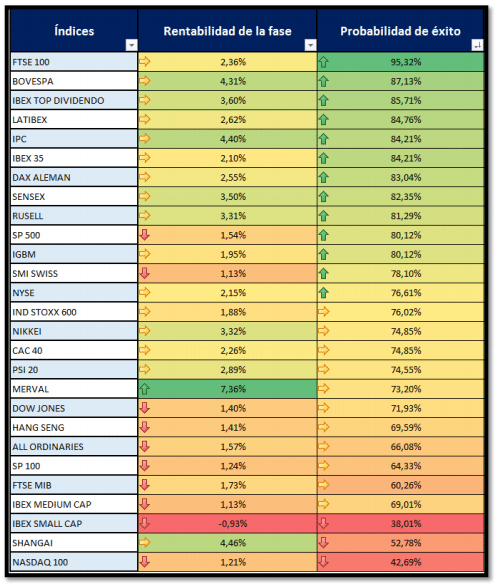
Entre los más alcistas podemos encontrar al indice ingles, el IBEX 35, el alemán, brasileño, etc. En definitiva, si nos fijamos en la imagen la gran mayoria de indices tienen unas probabilidades del 70% de ser alcista.
Pero operativamente que dicen los gráficos.
Empecemos con el SP500
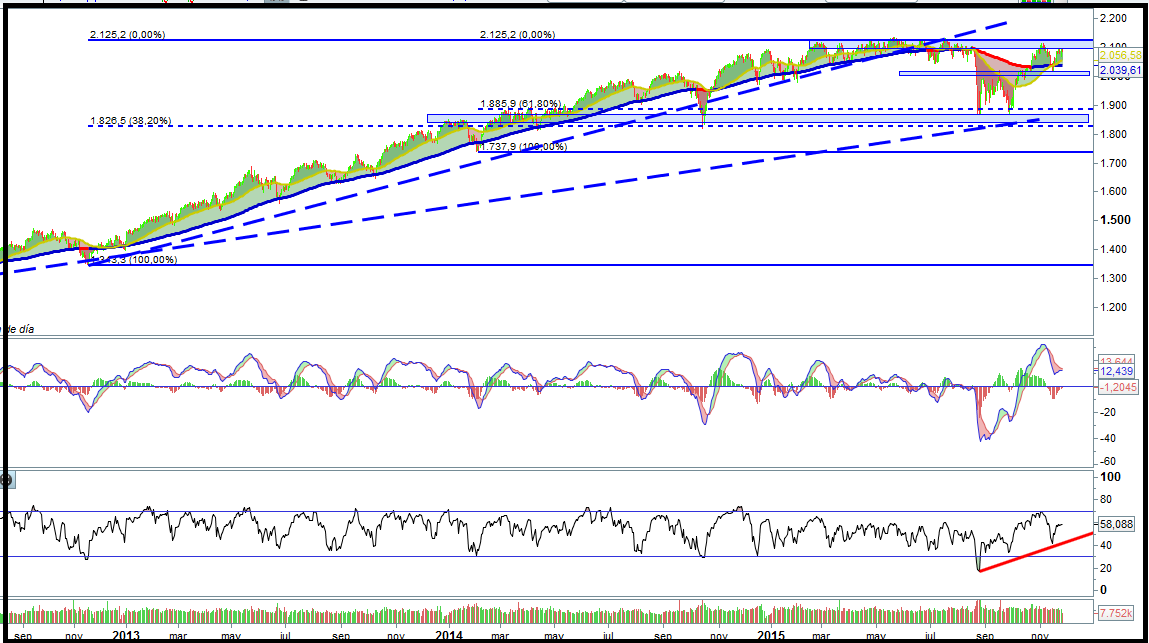
En el SP500 vemos como el precio a inicios del 2013 inicio una aceleracion de su tendencia alcista como se aprecia en la directriz secundaria marcada con una mayor inclinación de la misma. Sin embargo, a finales del primer semestre del 2015, se produjo la perforacion de la misma provocando que el precio vaya a buscar niveles previos de soporte como el nivel de los 1900 puntos, donde se produjo un momento óptimo operativo,
Actualmente, el indice norteamericano se aprecia como se encuentra en una situación alcista en el corto plazo, pero se tiene que enfrentar al nivel de resistencia actual los 2140 puntos.
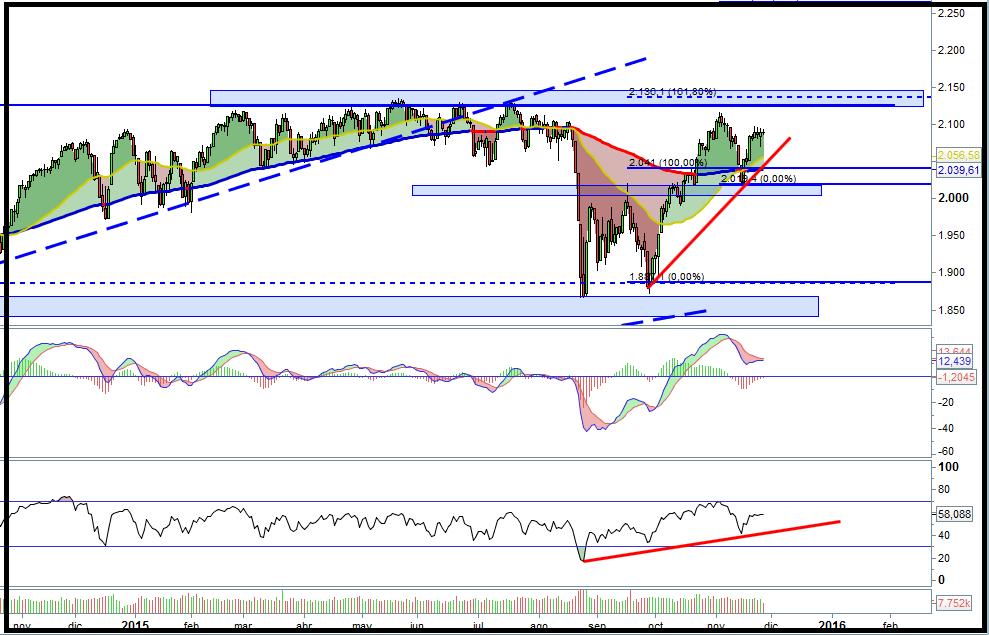
En la imagen se observa como el precio se tiene que enfrentar a un fuerte nivel de resistencia, por una parte por la multitud de ocasiones que ha sido probado a lo largo del año y por otra por la proyección de fibonacci la cual sitúa la zona de los 2140 como expansión del 161% de la expansión del ultimo tramo alcista en el corto plazo.
Con esto se puede entender que se puede producir una corrección de este movimiento alcista durante los proximos dias.
Es importante que el precio mantenga las directrices alcistas y que no corrija por debajo de los 2000 puntos, para que la estructura alcista que esta formando no se vea deteriorada, desalentando la búsqueda de operaciones en el mes de diciembre en Estados Unidos.
En el caso de Europa, vamos a destacar el DAX alemán el cual acaba de romper su directriz bajista.
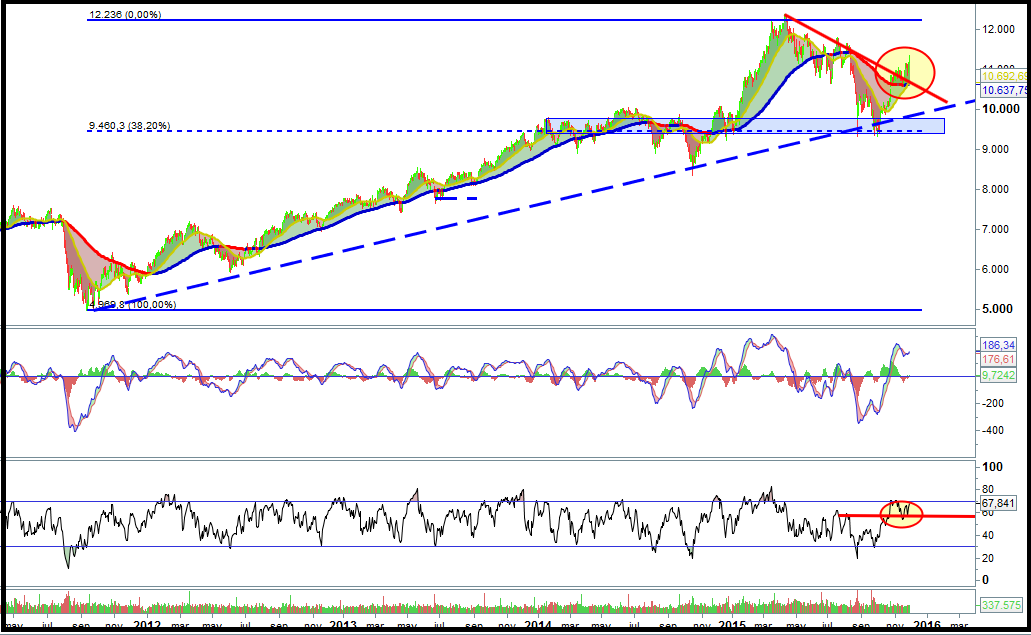
El índice alemán se aprecia como va en busca de atacar el nivel de resistencia actual, los 12000 puntos, todo esto después de apoyar en su directriz bajista en un movimiento correctivo con el que el precio alcanzo el retroceso del 38% de Fibonacci.
El CAC40
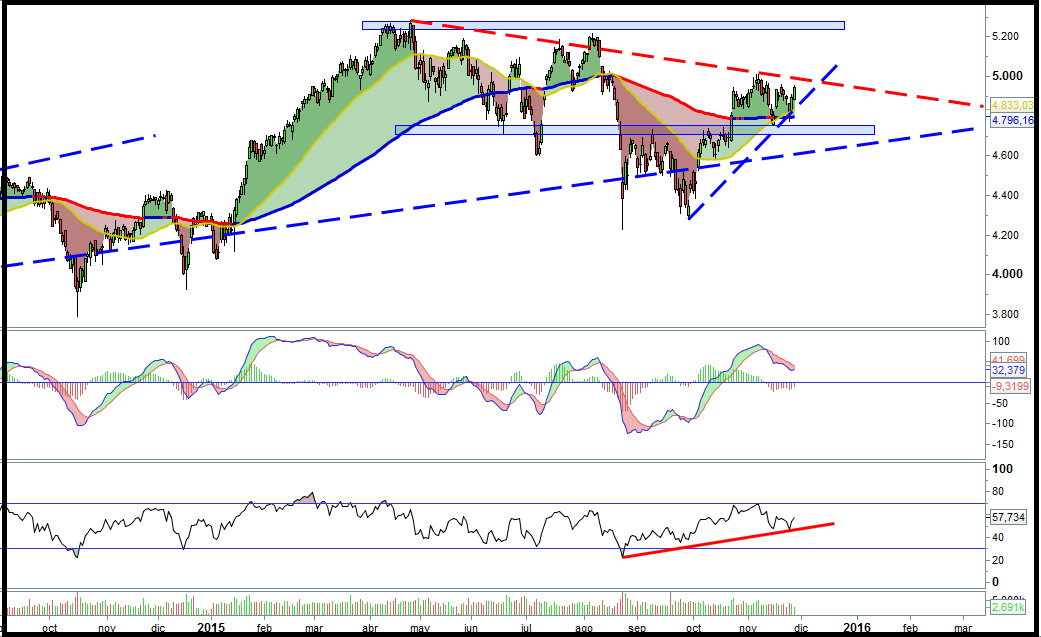
El CAC40, por su parte, se esta enfrentando en estos momentos a la directriz bajista formada con los máximos decrecientes, en el gráfico hemos marcado como niveles a vigilar, como 4796 como nivel de soporte y los 5000 como nivel de resistencia el cual ha de superar para que se pueda mantener la estructura alcista de corto plazo.
Pero ¿y el IBEX 35?
Hemos visto que el IBEX 35 estacionalmente es uno de los valores más alcistas en diciembre, sin embargo, esto no es motivo suficiente para justificar una operación alcista en el índice, lo más importante, siempre es el comportamiento del precio.
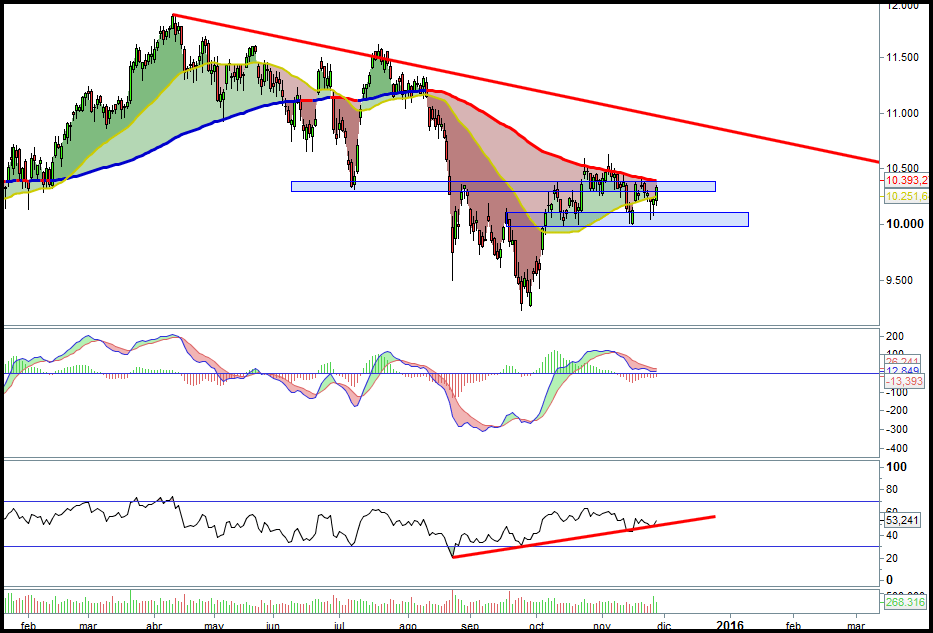
En el caso del IBEX35, técnicamente en el corto plazo se encuentra en una situación delicada, en la que se observa como se encuentra en un nivel de resistencia de corto plazo en el que han coincidido niveles de resistencia estático, y la media móvil la cual esta frenando el ascenso del IBEX35, el cual se encuentra por debajo de la media móvil de 150. Esto quiere decir, que en el corto plazo, se encuentra en una situación bajista, todo lo contrario a lo que indica la estacionalidad. De hecho, la situación actual parece más propicia para buscar operaciones en corto que posicionandonos largos.
Por ello hemos marcado niveles a vigilar en el IBEX, como nivel de resistencia están los 10500 puntos, como nivel de soporte los 10000.
En el caso del IBEX no parece que vaya a posicionarse alcista para el mes de diciembre, sin embargo, ello no quiere decir que no hayan valores óptimos para operar en función de la estacionalidad dentro del IBEX, de hecho en próximas publicaciones se realizara un estudio sobre la estacionalidad del IBEX35 tal y como se viene haciendo mensualmente.
En el caso del índice, estaremos alerta ante la linea directriz alcista marcada en el RSI con la que nos servirá de aviso, no señal de compra, de un posible impulso bajista, en caso de que se corte a la baja por el oscilador. Siendo un preaviso de que el precio tiene posibilidades de cortar a la baja al nivel de soporte actual en los 10000 puntos.
|
| Available Stock | Agustín Burgos Baena, analista y redactor de Enbolsa.net y creador de Experts Training |
| Misc | Place extra thumbs/images of product here |
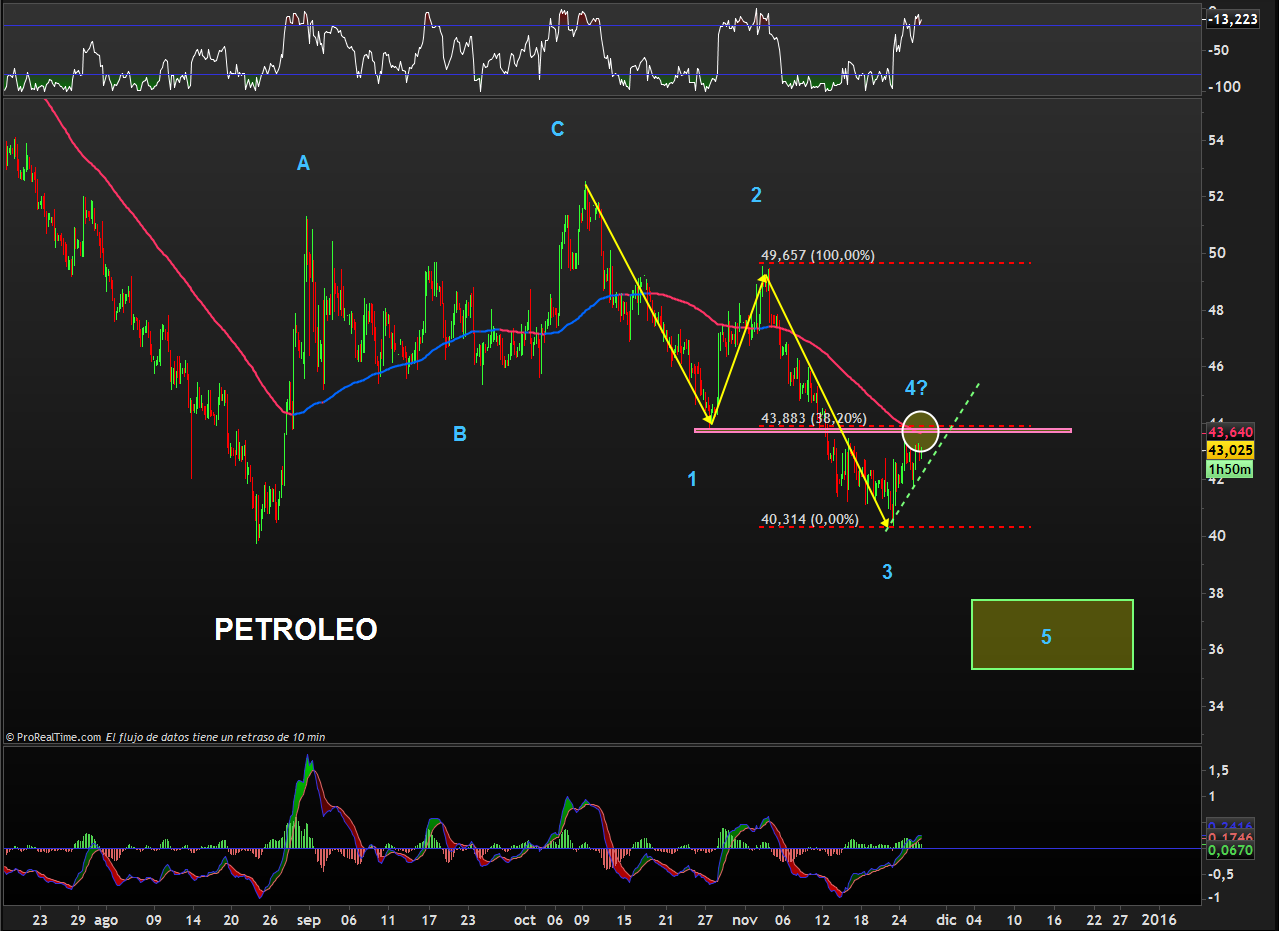
Zonas operativas para los proximos dias. Ibex, Petroleo y Audusd
|
|
|---|---|
| Item Name | Agustín Burgos Baena, analista y redactor de Enbolsa.net y creador de Experts Training |
| Price | $99.99 |
| Description |
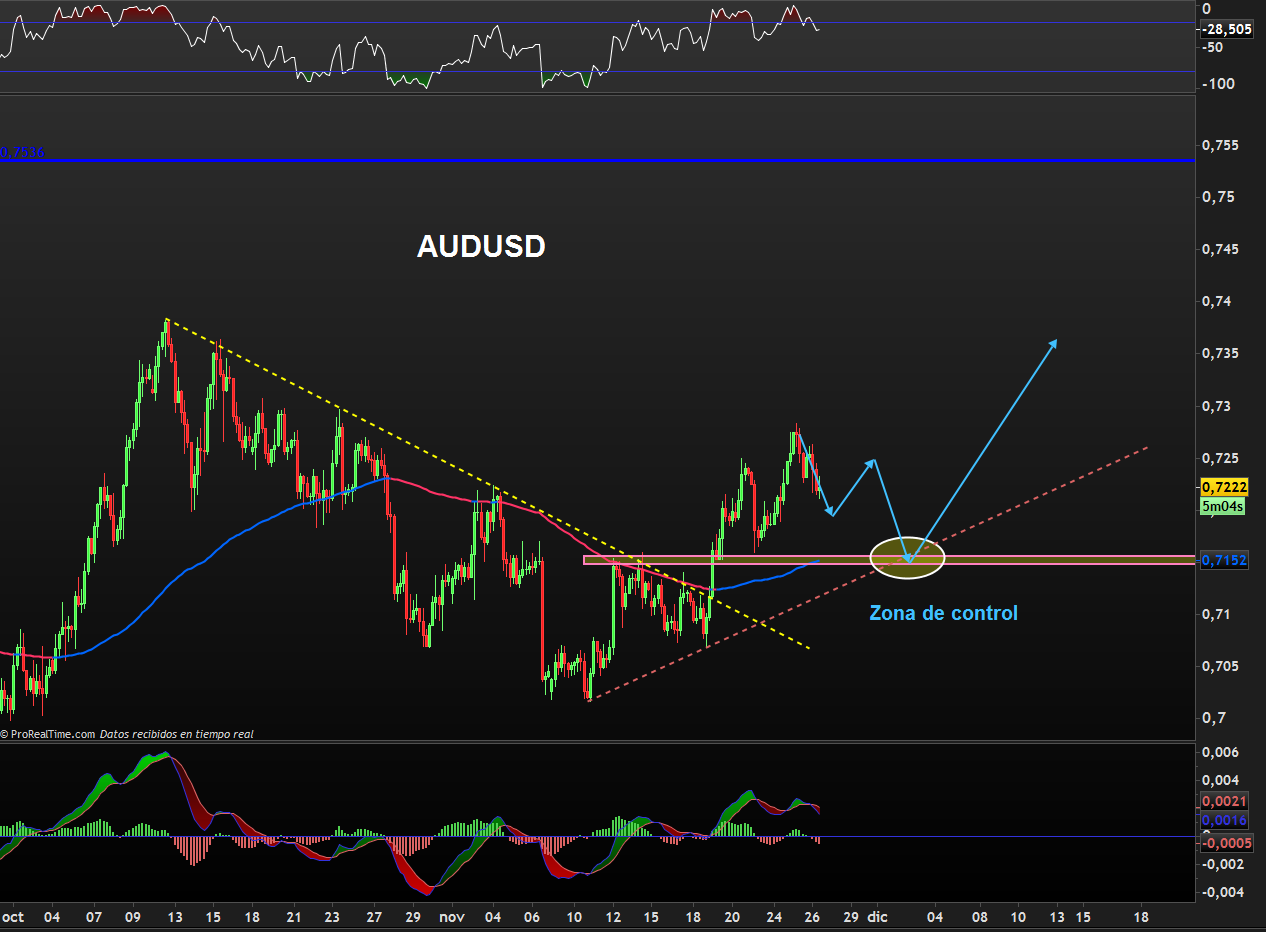
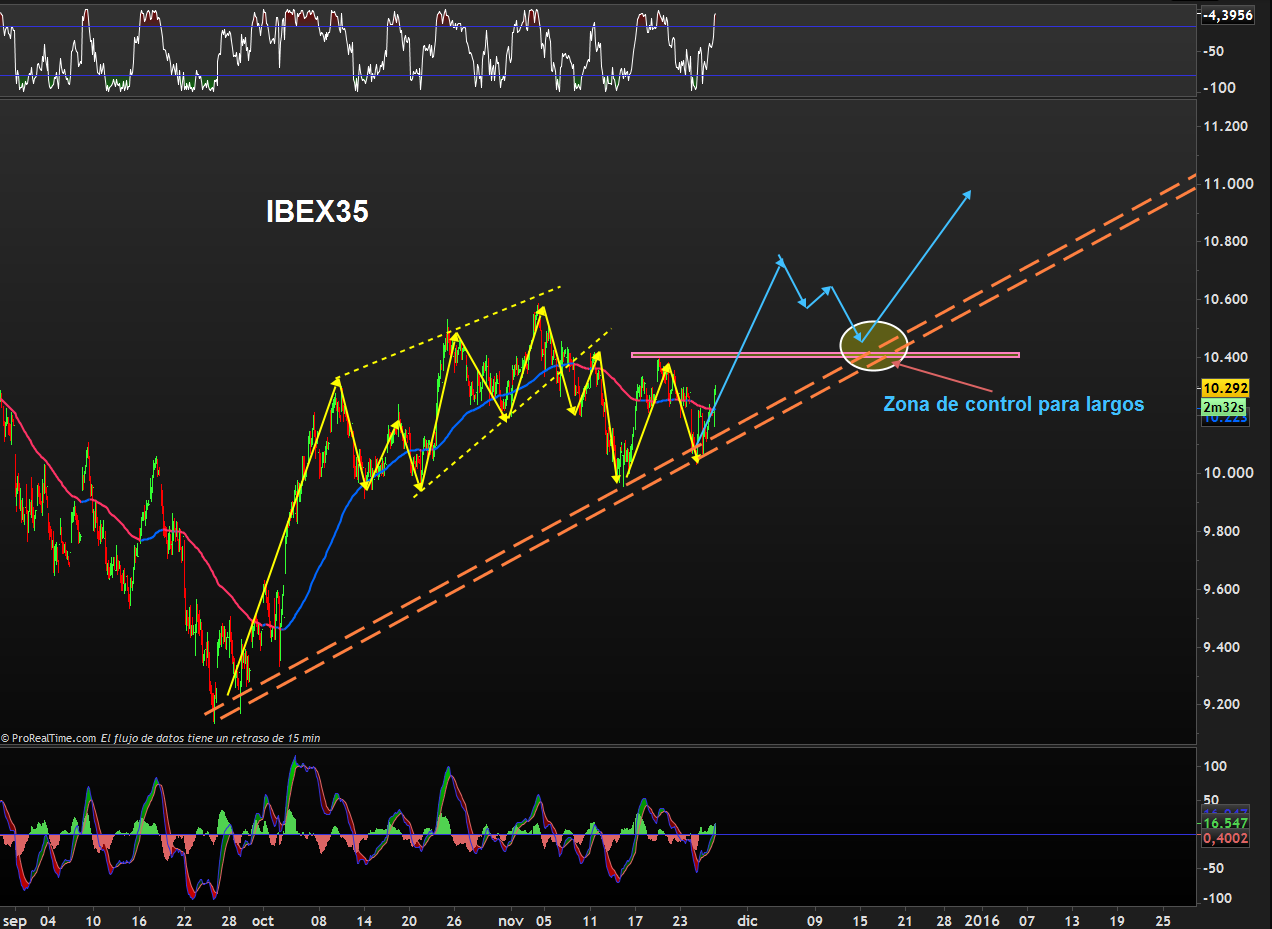
Es importante cuadno vamos a invertir tener claro cual va a ser una posible zona de control operativa, donde podeamos entrar en el mercado de forma óptima.
Para ello desde EnBolsa.net utilizamos la Unificación de criterios que nos ayuda a detectar las futuras zonas de control.
Esas zonas son aquellas en donde más atención tenemos que prestar al activo y el lugar para plantear un plan estrategico, por tanto, cuando el activo llegue a ese nivel siguiendo la ruta marcada, podremos establecer un plan estrategico, antes no debemos construir dicho plan.
Si desea recibir de forma gratuuita nuestras ideas de trading y planes estrategicos solo tiene que suscribirse aqui
   |
| Available Stock | Stock count here! |
| Misc | Place extra thumbs/images of product here |
miércoles, 25 de noviembre de 2015
viejo
 |
|
|---|---|
| Item Name | Product Name Goes here! |
| Price | $99.99 |
| Description | Canoso y grodo |
| Available Stock | Stock count here! |
| Misc | Place extra thumbs/images of product here |

